Winter Operations: De-icing, Holdover Times and Contaminated Runways
Winter does not make flying dangerous. It makes it slow, and it makes it arithmetic.
Every departure gains a de-icing step with a clock attached. Every runway gains a condition code that changes the distance required to stop. Every arrival rate falls because clearance equipment has to occupy the surface. None of that is dramatic, and together it is why a snowy morning turns a working schedule into a queue by lunchtime.
The clean aircraft principle#
The rule is absolute and it is the foundation of everything else: an aircraft may not take off with frost, ice, snow or slush adhering to any critical surface. Not a thin layer, not if it looks like it will blow off, not if the delay is expensive. The reason is the same as for in-flight icing — the wing is a shape, and contamination changes it — but on the ground it happens at exactly the moment the margins are thinnest.
- Frost on the upper wing surface is enough to matter, even when it is barely visible.
- Contamination is checked by inspection, not by assumption.
- Cold-soaked fuel frost can form on a wing on a warm day after a long flight.
- Snow that appears dry can be hiding a layer of ice beneath it.
- The final responsibility for the check sits with the commander.
This is one of the few areas in aviation with no judgement scale at all. There is no acceptable amount of contamination.
De-icing and anti-icing are two different jobs#
| Fluid | Job | Behaviour |
|---|---|---|
| Type I | De-icing — removes contamination | Heated, low viscosity, runs off quickly, minimal protection |
| Type II | Anti-icing — protects | Thickened, stays on the wing, sheds during the takeoff roll |
| Type III | Anti-icing for slower aircraft | Sheds at lower rotation speeds |
| Type IV | Anti-icing — longest protection | Most viscous, longest holdover time |
A one-step treatment removes and protects with a single fluid; a two-step uses Type I to clean and then Type II or IV to protect. Which is used depends on the conditions and the operator’s procedure.
Holdover time, and why it collapses#
The holdover time is the period during which anti-icing fluid can be expected to prevent ice forming on the treated surface. It is read from published tables against the fluid, the concentration, the outside air temperature and the type and rate of precipitation — and it starts at the beginning of the anti-icing application, not at the end.
| Condition | Effect on holdover |
|---|---|
| Light snow, −3 °C | Tens of minutes with Type IV |
| Moderate snow | Substantially shorter |
| Heavy snow | Very short — sometimes single-digit minutes |
| Freezing drizzle | Short, and the tables have hard limits |
| Freezing rain | Extremely short; some conditions are outside the tables entirely |
| Ice pellets | Restricted or not permitted at all |
When the holdover expires before takeoff, the aircraft is de-iced again. It is not estimated, extended or judged by eye — which is precisely why a heavy snow morning produces a departure queue rather than a slow trickle.
Contaminated runways#
On the ground the runway itself becomes a variable. Contamination — water, slush, snow, compacted snow or ice — reduces braking action and, for depths above a threshold, adds displacement and impingement drag during the takeoff roll. Modern reporting uses a runway condition code from 6 (dry) down to 0 (worse than poor), assessed per third of the runway, and the crew computes performance against it.
| Code | Description | Typical surface |
|---|---|---|
| 6 | Dry | Dry |
| 5 | Good | Frost, dry snow up to 3 mm |
| 4 | Good to medium | Compacted snow at −15 °C or below |
| 3 | Medium | Wet snow, dry snow over 3 mm, compacted snow above −15 °C |
| 2 | Medium to poor | Standing water or slush over 3 mm |
| 1 | Poor | Ice |
| 0 | Less than poor | Wet ice, water on compacted snow |
The step from code 3 to code 1 is not a small change in the numbers. It can move a landing from comfortable to not legally possible at the planned weight.
Why the schedule falls apart#
- Every departure gains a de-icing step, and there is a finite number of rigs and pads.
- Holdover clocks force re-treatment when the queue moves slowly, which lengthens the queue further.
- Runway clearance closes one surface at a time, so movement capacity drops while the demand is unchanged.
- Reduced braking action increases spacing between arrivals.
- Crew duty limits start to bite on a day of long delays, producing cancellations that are not weather-caused in any direct sense.
The feedback loop in step two is the important one. De-icing capacity is the constraint, and a queue that forces re-treatment consumes the very capacity it is waiting for.
What passengers see, and what it means#
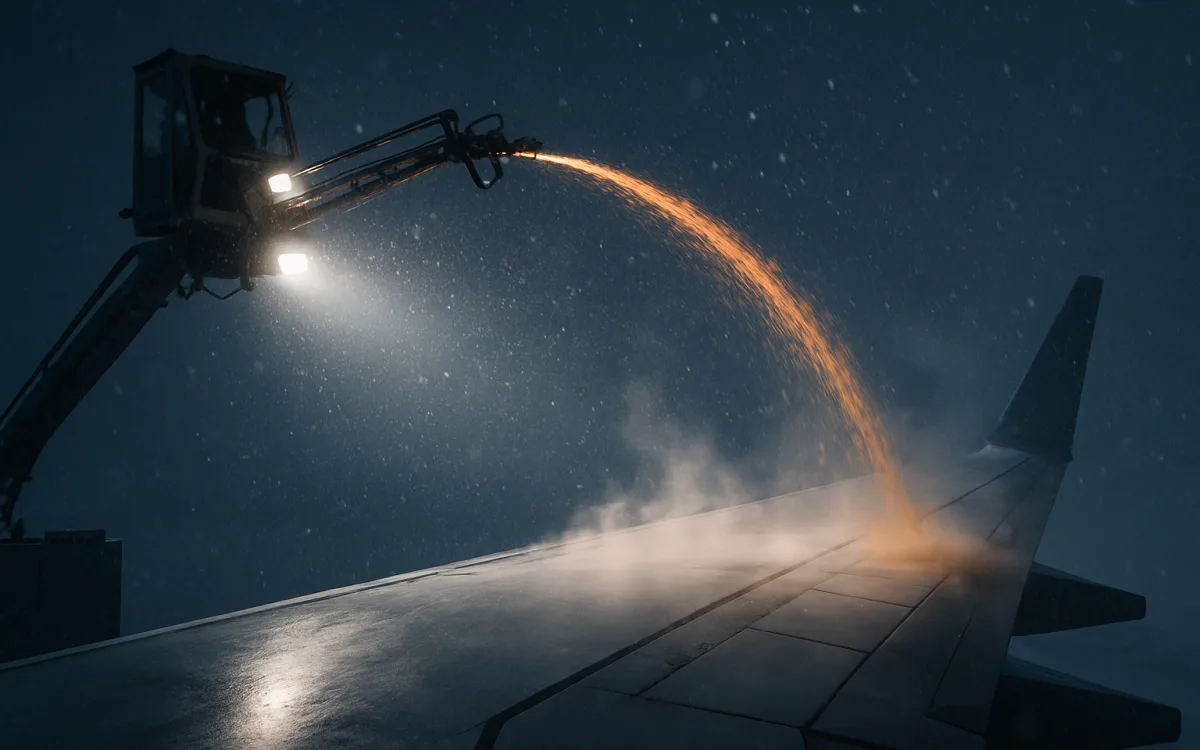
- A long wait on stand or at a remote pad with a vehicle spraying the wings — normal, and the safest part of the morning.
- Orange or green fluid running off the wing during the takeoff roll — that is the anti-icing fluid shedding, exactly as designed.
- A return to the pad after a long wait — the holdover expired, and the alternative is not acceptable.
- Long taxi times behind a plough or sweeper — clearance takes priority over movements.
None of this is a sign that something is wrong. It is a sign that the process is being followed at the point where it is most inconvenient to follow it.
Frequently asked questions
Why do planes need de-icing?
Because a wing works by its shape, and frost, snow or ice on the upper surface disrupts the airflow enough to reduce lift and raise the stall speed at the moment the aircraft has the least margin — during rotation and initial climb. The clean aircraft principle is absolute: nothing takes off with contamination adhering to a critical surface. De-icing fluid removes what is there; anti-icing fluid then protects the surface for a calculated period called the holdover time.
What is holdover time?
The period during which anti-icing fluid can be expected to prevent ice forming on treated surfaces, read from published tables against the fluid type and concentration, the outside air temperature and the type and rate of precipitation. It begins when the anti-icing application starts. If it expires before the aircraft takes off, the treatment must be repeated rather than estimated or extended. In heavy snow or freezing rain the times can fall to a few minutes, which is what turns a snowy morning into a departure queue.
Can aircraft land on a snow-covered runway?
Often yes, within calculated limits. Runway condition is reported as a code from 6 for dry down to 0 for wet ice, assessed for each third of the runway, and the crew computes the landing distance required against that code, the aircraft weight and the wind. Compacted snow at low temperature gives reasonably good braking; wet ice gives almost none. The step from medium to poor is not a small adjustment — it can make a landing at the planned weight impossible, which is when a diversion becomes the answer.
aircraft de-icingholdover time explainedrunway condition codewinter flight delayscontaminated runway landingclean aircraft concept