Crosswind and Runway Condition: Turning Wind Into a Number
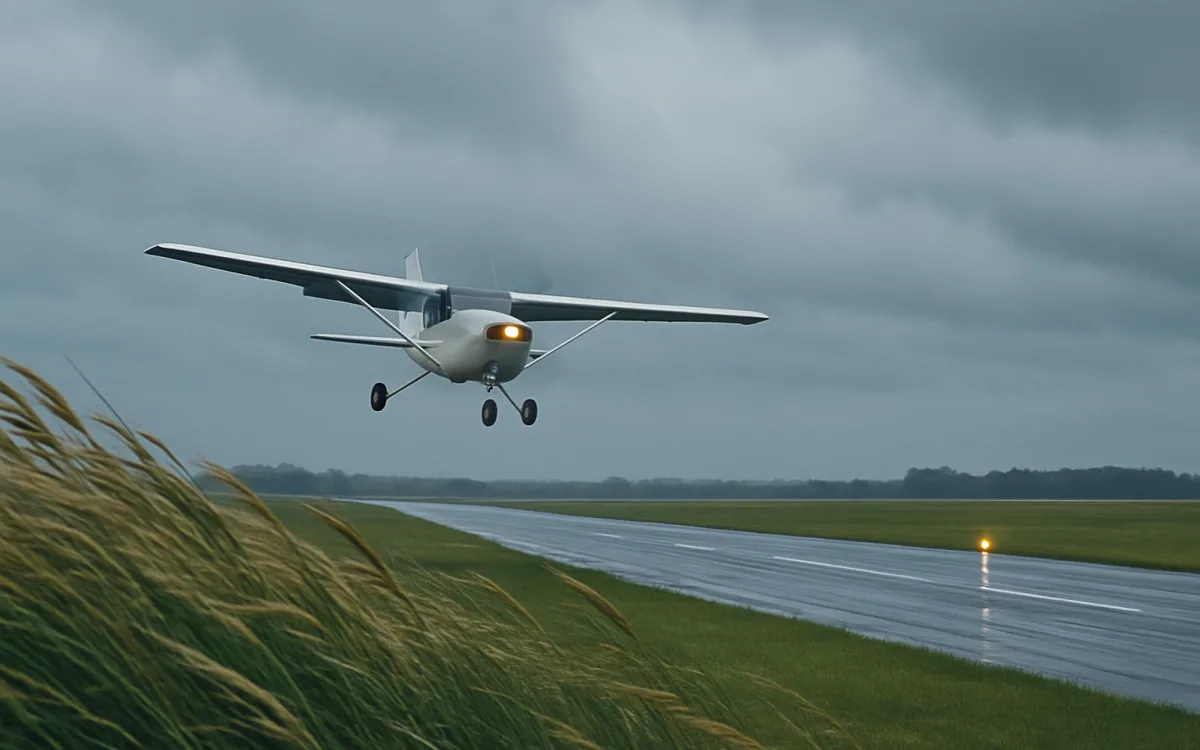
A reported wind is not a limit. It is two numbers that have to be resolved against a runway heading before they mean anything, and the part that matters is the component across the runway rather than the total.
The arithmetic is simple enough to do in your head, and doing it in your head is the point: by the time you are on the approach, the wind has changed twice and the number you calculated on the ground is history.
The calculation#
The crosswind component is the reported wind speed multiplied by the sine of the angle between the wind and the runway. Nobody computes a sine on an approach, so the working approximation is the clock rule, and it is close enough for a decision.
| Angle to runway | Fraction of wind speed | Example: 20 kt wind |
|---|---|---|
| 10° | Roughly 1/6 | 3 kt |
| 20° | Roughly 1/3 | 7 kt |
| 30° | 1/2 | 10 kt |
| 45° | Roughly 0.7 | 14 kt |
| 60° | Roughly 0.9 | 17 kt |
| 90° | All of it | 20 kt |
Runway numbers are magnetic and METAR wind is true. In most of the world the variation is a few degrees and does not change the answer; at high latitudes it can be large enough to matter.
Which wind figure to use#
Always the gust, not the mean. A wind of 24012G28KT is a 28-knot wind for the purposes of a limit check, because the gust is what arrives at the moment of the flare. The mean is for planning fuel and the approach; the gust is for the limit.
- Use the gust value against the crosswind limit, every time.
- If a variable direction group is present — 240V300 — check the worst bearing in the arc, not the mean.
- The tower wind is measured near the middle of the runway; conditions at the threshold and in the flare can differ.
- Wind over obstacles, hangars or trees near the threshold produces mechanical turbulence that no report shows.
- On a gusty day the headwind component varies too, which changes the approach speed additive.
The variable group is the one people ignore. A crosswind that is comfortable at 240° and outside limits at 300° is reported as being at both.
What a demonstrated crosswind is, and is not#
The figure in the flight manual is usually a maximum demonstrated crosswind — the strongest crosswind in which the aircraft was shown to be controllable during certification. It is not necessarily a structural or regulatory limit, and it is frequently misread in both directions: as an absolute prohibition, or as a soft suggestion.
- Demonstrated means it was tested there, not that more is impossible.
- Operators routinely impose their own limits, which are lower and are hard limits.
- Limits are usually reduced for wet or contaminated runways, sometimes substantially.
- Some aircraft have separate limits for takeoff and landing, and for autoland.
- Crew experience and recency are the informal limit, and the one most often exceeded.
Reduced-limit tables for contaminated runways are the part to read before the day you need them. That is where a comfortable 25-knot crosswind becomes a 15-knot one.
Runway condition, and why it moves the limit#
Braking action and directional control both come from the tyre’s grip. Water, slush, snow and ice reduce it, so the ability to keep the aircraft straight against a crosswind falls at the same time as the stopping distance rises. That is why the two subjects are the same subject.
| Condition code | Braking action | Effect on crosswind |
|---|---|---|
| 6 — dry | Full | Published limit applies |
| 5 — good | Near full | Usually the published limit |
| 4 — good to medium | Reduced | Operator reduction typically begins |
| 3 — medium | Noticeably reduced | Substantial reduction |
| 2 — medium to poor | Poor | Large reduction, aquaplaning risk |
| 1 — poor | Very poor | Severe reduction; ice |
| 0 — less than poor | Almost none | Operations normally suspended |
Aquaplaning deserves its own mention: above a speed that depends on tyre pressure, a layer of standing water can lift the tyre off the surface entirely, at which point braking and steering both go to almost nothing.
Reading it off the report#
- Take the wind group, and use the gust figure.
- Compare the direction against the runway in use; if a variable group is present, use the worst bearing.
- Apply the clock rule for the crosswind component and the complementary figure for head or tailwind.
- Check the runway condition report — a RCC group, a CLRD entry or the reported braking action.
- Apply the operator’s reduced limit for that condition, not the dry-runway figure.
- Check the tailwind component separately; limits there are much lower, usually around 10 to 15 knots.
Step six is skipped surprisingly often. A tailwind limit is far tighter than a crosswind limit and it is easy to focus on the cross component alone.
What a passenger sees#
- An aircraft on final pointing noticeably away from the runway — that is the crab, and it is the normal technique.
- A late alignment just before touchdown, sometimes with a wing low.
- A firm landing on a wet or contaminated runway; that is deliberate, to break through the water film and get the wheels turning.
- A go-around when a gust arrives at the wrong moment — a normal manoeuvre and not an emergency.
- A runway change, which is why the aircraft suddenly taxis further than expected.
The crab looks alarming and is the correct answer to a crosswind. The aircraft is tracking the centreline while pointing into the wind, which is exactly what it should be doing.
Frequently asked questions
How do you calculate a crosswind component?
Multiply the wind speed by the sine of the angle between the wind and the runway. In practice, use the clock rule: at 30° take half the wind speed, at 45° take about 70 per cent, at 60° about 90 per cent, and at 90° all of it. Always use the gust figure rather than the mean, because the gust is what arrives in the flare, and if a variable direction group is reported, use the worst bearing in the arc rather than the average.
What is the maximum crosswind for landing?
There is no universal figure. The flight manual usually publishes a maximum demonstrated crosswind — the strongest tested during certification — which is often not a structural or regulatory limit, and operators then impose their own lower and firmer limits. Those limits are typically reduced further for wet or contaminated runways, sometimes substantially. Crew experience and recency form the practical limit, and it is the one exceeded most often.
Why does a wet runway reduce the crosswind limit?
Because both stopping and steering come from tyre grip, and water reduces it. With less grip the aircraft is harder to hold straight against a crosswind at the same time as the landing distance required increases. Above a speed that depends on tyre pressure, standing water can lift the tyre off the surface entirely — aquaplaning — at which point braking and directional control are almost gone. That is why runway condition codes and crosswind limits are read together.
crosswind componentcrosswind landing limitrunway condition codehow to calculate crosswindaquaplaning aviationbraking action report